VENTILATION 101: Keeping Your Cows Cool
I remember a conversation with a dairyman from Stephenville, Texas in the early 1990’s, about ventilating dairy barns. At the time, he was touring a small tie stall barn in Wisconsin where Aerotech had recently installed 48” fans in the end wall, and created a “wind tunnel” through the barn that we called tunnel ventilation. I think he believed I was from outer space, because what we were doing in Wisconsin seemed to have no practical application for the large, open lot dairies common in the southwest.
In the nearly twenty years since that conversation, it has been exciting developing more sophisticated approaches to cooling cows. The transition has led to widespread acceptance of various ventilation methods and hundreds of products to provide mechanical air movement and various means of air-cooling. In many respects, the dairy industry has become the most sophisticated and creative enterprise using ventilation systems in agriculture. Recent studies have shown that modern, high producing cows produce more metabolic heat and react to heat stress at a temperature-humidity index much lower than previously believed. The research confirms the economic benefit of well-designed ventilation systems.
All this creativity in ventilation design also creates some confusion. Following is a “primer” on the major considerations and questions in designing the right ventilation system for your operation.
First, for any given facility there are several “correct” ways to ventilate. Choosing what is most effective and most practical requires some careful evaluation. Following these decision steps will lead to the right system for you.
STEP 1: MOVE THE AIR
The most fundamental step in cow cooling is to create a breeze through the barn to get a “wind chill” effect. Air moving over the cow will remove heat produced by cows at a faster rate than simply radiating heat into still air. The first question, then, is “what is the best way to create a breeze for the cows.” Here are some answers:
NATURAL VENTILATION: Can be effective under the right conditions. Natural ventilation works in two ways. One, if there is a good natural breeze, the air movement across the barn on a breezy day is effective. Second, the “chimney effect” of warm air rising and exiting the barn through the ridge has a cooling effect. The downfall of relying on natural ventilation is that the warmer the outdoor temperature, the slower the chimney effect works, just the opposite of what you want. And, the wind doesn’t always blow, although a few of my Texas friends might argue with that.
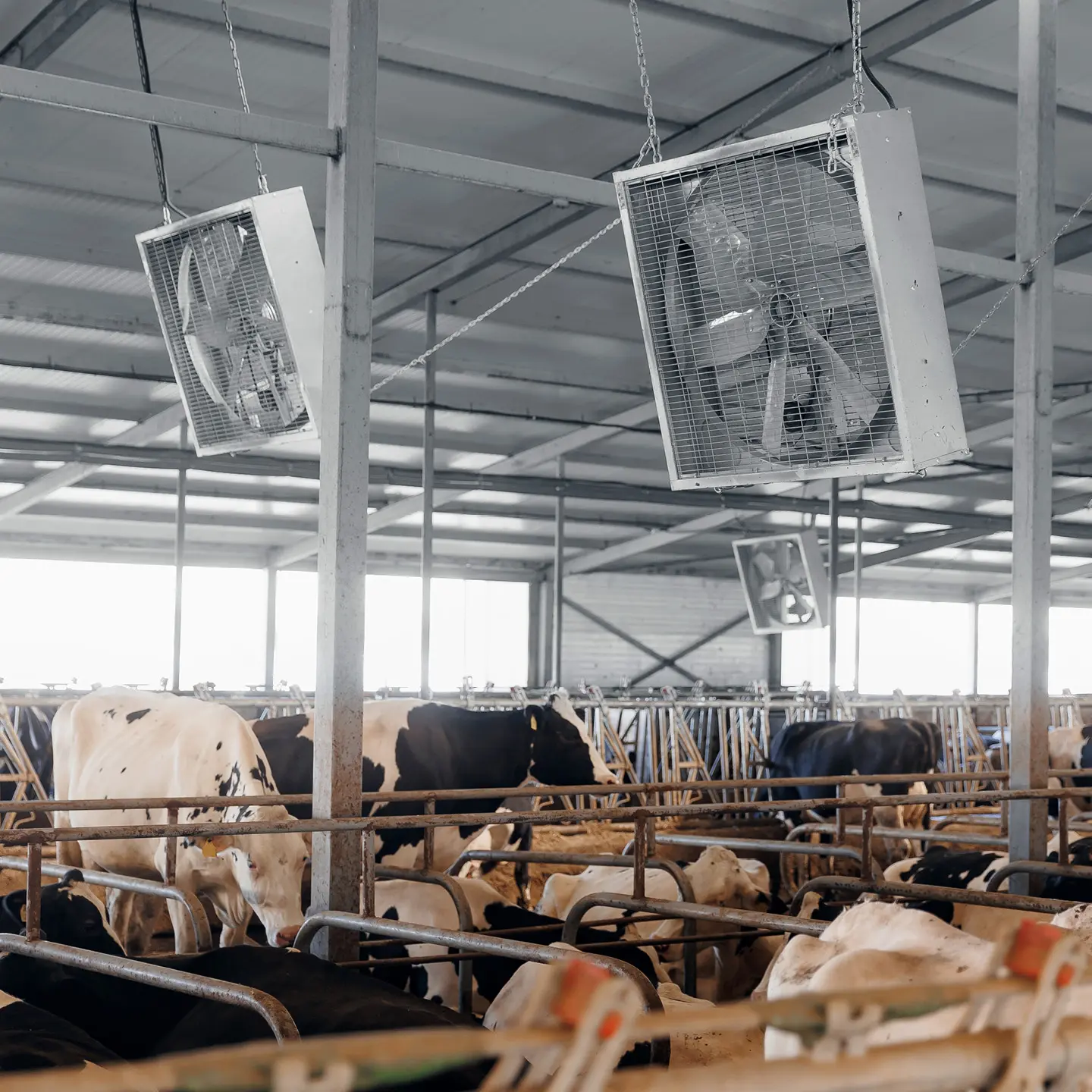
STIR FANS: Because natural ventilation is by definition dependent on weather conditions, most naturally ventilated barns are augmented with stir fans. A large variety of stir fans is on the market, but my preference is an Aerotech 48-51” Apex fan with an orifice, rather than an open or basket fan. The orifice gives direction to the airflow, resulting in better air velocity down the bed line. The larger fan diameter provides higher total airflow, resulting in more effective heat removal from the cow.
POSITIVE VENTILATION: This system is less commonly used, but can be highly effective in certain applications. For example, a parlor/holding barn, or transfer lanes may be a good place to incorporate this system. The essential design is to use traditional exhaust fans along the outer walls, blowing into the barn instead of exhausting. The air coming off the fan blade has velocity, similar to a stir fan, but is designed as a fresh air inlet to the barn. We recently used this concept on an open front maternity barn at Kansas State University, with evaporative cooling outside the fans. The result was a good wind speed in the barn, using cooled air, resulting in a very nice calving environment.
TUNNEL VENTILATION: Tunnel ventilation has been the most widely used system in the upper Midwest. Tunnel ventilation consists of installing exhaust fans on one end of the barn, and an inlet, either cooled or non-cooled, on the other end of the barn. Aerotech was the first company to design an evaporative cooled tunnel system back in the early 1970’s. Proper design involves calculating desired wind speed across the cows, and also designing for a reasonable temperature gain of the air as it travels the length of the barn. Advantages of tunnel ventilation are higher air velocity, and using exhaust fans instead of stir fans removes more heat from the barn. A disadvantage is that a large portion of the air actually travels down the feed driveways with no contact with the cows. Installation of air baffles helps keep the air down at the cow level.
CROSS VENTILATION: Perhaps the most discussed and studied ventilation system for dairies in the past five years has been cross ventilation. Cross ventilation is not a totally new concept, having been used in poultry and swine facilities for many years. This design has some rather unique advantages for large dairy facilities. First, utilizing the low profile cross-ventilated design enables construction of larger facilities on a relatively small site footprint. For example, 4 four-row barns can be constructed as one 16-row barn and save the space required for separate barns. Construction costs can be lowered, and numerous operational efficiencies are gained by housing the cows in closer proximity to the parlor. Cross ventilated barns are typically 300-400’ wide, and the air is drawn uniformly across the width by installing exhaust fans along one side of the barn and using the other side as a cooled air inlet. Most designs result in average wind speed of 5 MPH across the barn, but utilization of air baffles over the beds can enhance the speed to 6-7 MPH at the beds.
I won’t use this article to delve into the well documented production and reproduction efficiencies from these facilities, but a wealth of data exists, largely due to the work of Dr. John Smith and Dr. Joe Harner of Kansas State University.
P.S. Whichever system you select to create air movement, select high quality, energy efficient fans. Most reputable fan manufacturers test their fans at BESS laboratories at University of Illinois. http://bess.illinois.edu/ Look for a high cfm per watt rating.
STEP 2: COOL THE AIR
Once you determine which method of creating a breeze makes the most sense for your operation, you are ready for one of the most important and confusing decisions. While cooling the air is not always done, it can be a relatively economical way to improve cow performance. It is a fundamental fact of physiology; cooler air dissipates more heat from a cow’s body surface. Three systems are commonly used:
LOW PRESSURE MIST: Adding mist to the air under low pressure can provide some evaporative cooling, but is relatively inefficient. While it is the lowest cost cooling system, low pressure mist relies on larger water droplet size delivered with low line pressure, and the result is less evaporative cooling than other systems.
HIGH PRESSURE MIST: This is an effective system for air-cooling. HP mist relies on extremely high line pressures—1000 psi or higher—and very small water droplet size to provide a very fine mist to the air, which evaporates relatively effectively. The resulting water evaporation cools the air. The amount of cooling varies with the design of the system. Nozzle location, orifice size, pressure, and volume of water all affect cooling efficiency of high-pressure mist systems. Regulating the system is critical, because adding too much mist to the air creates wet surfaces, wet beds, and fog in the buildings. Properly designed and maintained, high pressure mist can be effective.
EVAPORATIVE (PAD) COOLING: Pad cooling systems have been used in the livestock industry since the early 1970’s and are effective in all regions of the country. With pad cooling, a wall of cellulose fiber pads is constructed as the building air inlet. Water is circulated over the pad, and ventilation air is drawn through the pad. The evaporation of the water into the ventilation air-cools the air temperature. Excess water re-circulates in the system. A hot, dry climate is ideal for evaporative pad cooling. For example, a typical 95-degree summer day in Amarillo, Texas, would cool 21 degrees for an air temperature coming off the cooling pad of 74 degrees. But even more humid areas, like Lincoln, Nebraska, would experience 16 degrees of cooling on a 95-degree design day, for an inlet temperature of 79 degrees. In central Iowa, pad cooling may only result in a 10-12 degree temperature drop, but 12 degrees is very significant in dairy productivity.
P.S. Be prepared to perform some routine maintenance, no matter which cooling system you select. Blowing dust and debris can foul cooling pads, high-pressure nozzles are subject to plugging and wear, and if water source is not good some water treatment will be necessary.
STEP 3: WET THE COWS
Wetting cows as a cooling method is one of the oldest and simplest cooling options.
FEEDLINE SOAKERS: Are extremely effective at reducing core body temperatures. They are simple to manage and inexpensive. To be most effective, frequent on/off cycles are recommended. 1-1.5 minutes of soaking followed by 3.5-4 minutes of drying time is suggested. The soaking water volume must be enough to soak through the hair coat and wet the skin.
The negatives to feed line soakers is that they use a high volume of water, most of which ends up in the manure system. Also, cows are more productive when they spend more time lying in the beds, and soakers encourage them to stand up and move to the cooling source. Because we are already providing air movement in the barn, the distribution of the soaking spray frequently creates wet beds.
However, especially in the more humid climates where other cooling systems are less effective on several days a year, soakers can be a good supplemental source of cooling.
Another application would be in the holding pen, to provide additional core temperature cooling during the trip to the parlor.
P.S. Soakers are usually not necessary with either high-pressure mist or evaporative pad cooling systems, and the high water volume is a drawback, but may play a role as a supplemental system.
STEP 4: PROVIDE FOR WINTER VENTILATION
Winter ventilation for dairy barns has been often overlooked. While emphasis on cow cooling is understandably a priority, many winter systems have been no more sophisticated than just shutting off 90% of the summer fans.
In fact, winter environment is also critical to productivity. We strive for ammonia and moisture removal, by moving enough fresh air through the barn, while keeping it warm enough to limit freezing of manure lanes. There are several options to do this:
NATURAL VENTILATION WITH ADJUSTABLE RIDGE: This system would require a small opening on each sidewall, and a ridge that can be opened in winter to allow escape of moisture and gasses.
RIDGE FANS: We have successfully used ridge fans, designed to provide minimum winter ventilation rates. This design also requires small, uniform inlet openings on each sidewall. Using continuously operating, direct drive ridge fans may require less maintenance and more positive ventilation control than adjustable ridges.
AIR PURGE: This system utilizes existing summer fans and inlet, but operates about 25-30% of the fans to purge the air out of the building every 10-15 minutes.
P.S. The most critical component of a good cold weather ventilation system is the air inlet. Because we are ventilating with a very small quantity of air, it is important that the winter inlet provide small openings uniformly across the length of the barn. Several designs, ranging from an adjustable curtain high on the wall, to hinge, insulated air baffles; to commercially manufactured sidewall inlets are available.
STEP 5: TALK TO THE EXPERTS
The decisions described in this article should be discussed with experienced ventilation experts. Anyone can sell you fans, but more importantly you want to work with someone who is your partner in productivity. What is a correct answer for you and your operation may not be the correct answer to someone else. Making the right decision can lead to a highly productive and profitable enterprise.
About the Author: Rick Zimmerman - 19 years w/Aerotech Ventilation Systems, BS /MS University of Illinois, 35 years experience in the Ag industry. Munters Corporation, Aerotech Ventilation System • www.munters.us/aerotech • 1-800-227-2376 • aeroz@ameritech.net